
Intelligence and risk advisory
Know how you're targeted.
Exarma is an intelligence practice concerned with how organisations and the people who lead them are targeted, whether by direct approach or through the narratives that shape how they are seen. We assess that exposure, reduce it, and measure the result.

Who we work with
- Mining and energy
- NGOs and development
- Corporates operating overseas
- Security providers
- Government
Three forms of assessment, one discipline.
All servicesThreat and environment assessment
An independent assessment of the conditions surrounding an operation, a project, an event or an entry into a new market: the political, criminal, community and information factors at work, the actors with the intent and capability to interfere, and the indicators that would precede it.
Exposure assessment
An assessment, conducted from a hostile actor's perspective, of how an organisation, its leadership and its principals could be selected and approached: what is discoverable, who is accessible, and which approaches follow. It is followed by remediation and a later re-assessment.
Narrative analysis and defence
Analysis of how narratives about an organisation are formed, carried and received; early identification of organised campaigns; assessment of what they are likely to produce; and work with the organisation's own leadership and staff to make them more resistant to narrative attack.
How the work is delivered
Written assessment, briefings for leadership teams and boards, standing reporting, and the development of in-house intelligence capability, so that what is learned remains with the client.
Targeting is a process, not an event.
It begins with research.
Before any approach is made, the target has been studied: what is public, who is close to them, where their routines are predictable. Most of that material remains available to anyone who looks.
Narratives precede action.
Protest, blockade, fraud and threats to individuals are increasingly preceded by an identifiable shift in what is being said and by whom. The indicators are observable to those reading for them.
Protection without analysis has a gap.
Physical and digital protection address the means of an attack. They do not address the planning that precedes it, which is where exposure is created and where it can most economically be reduced.
The analysis behind the protection.
Two pedigrees
Exarma's work rests on two disciplines, holistic intelligence assessment and narrative analysis, grounded in defence and government intelligence experience of threat, targeting and the information environment. Where an engagement requires capability beyond analysis, it is drawn from a vetted associate network and declared on the proposal.
Measured outcomes
Each engagement is defined by a written measure of success agreed at the outset and reported against at the close, including where the assessment proved wrong.
Defined scope
Scope, lead time and deliverables are agreed in a single conversation before work begins, and the engagement is priced to that scope.
Confidential by default
We never publish client names or case details. Sensitive conversations move to encrypted channels.
Practical guides you can use today.
One-page guides drawn from how we work. Free to download and share with your team.
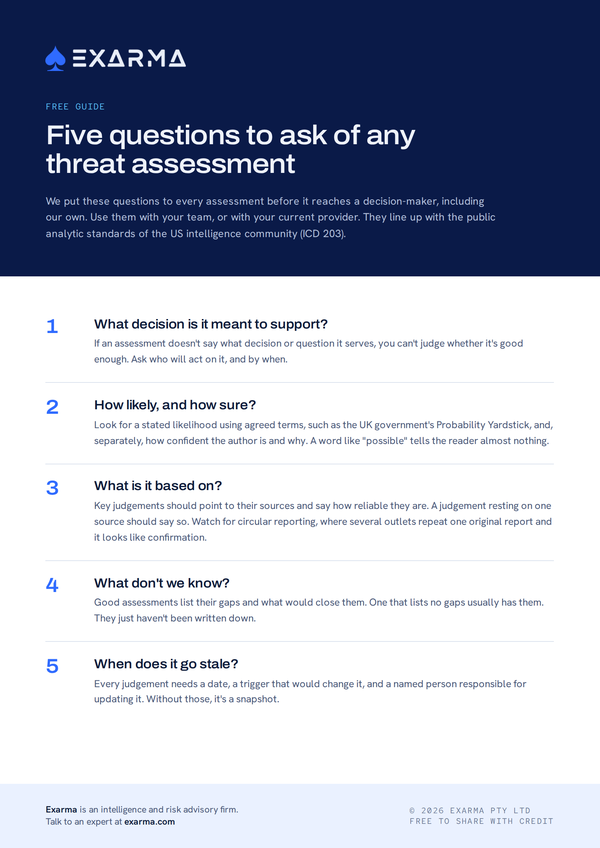
Five questions to ask of any threat assessment
The checks we run before an assessment reaches a decision-maker.
Download PDF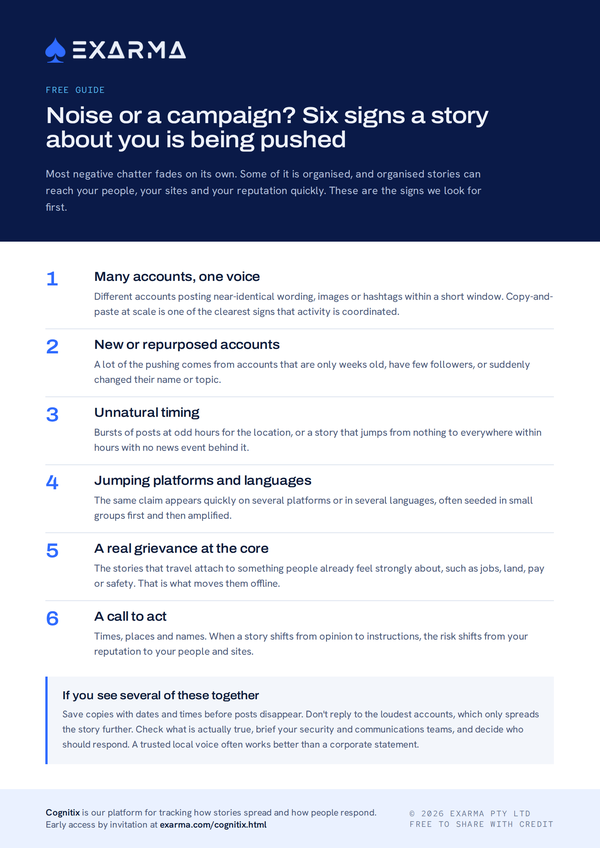
Noise or a campaign? Six signs a story about you is being pushed
How to tell ordinary chatter from an organised effort, and what to do next.
Download PDF
See how narratives move.
A narrative analysis desk developed by Exarma and in use on its own work: continuous collection on a country, sector or topic, a standing baseline, and measurement of what changes. Early access is by invitation.
Describe the event, the site or the person.
One conversation is sufficient to define scope, lead time and price. An analyst replies within one business day, and the exchange moves to an encrypted channel once contact is established.